


Syllabus: GS3/Economy
Context
- Recently, Bharatiya Reserve Bank Note Mudran Pvt. Ltd. (BRBNMPL) invited Expressions of Interest (EoI) for supplying polymer substrate sheets with embedded security features.
What are Polymer Banknotes?
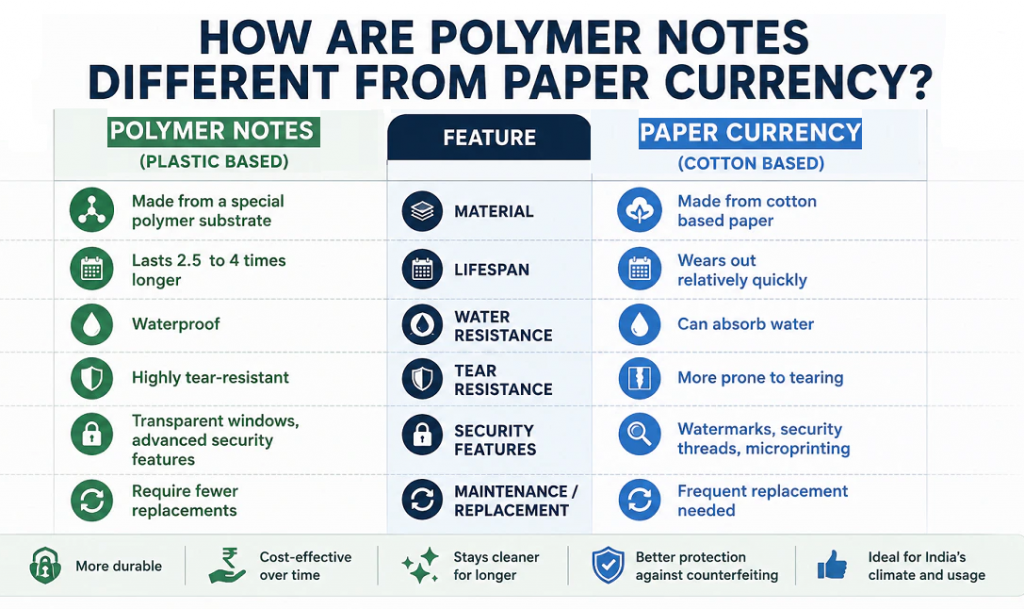
- These are made from biaxially orientated polypropylene (BOPP), not paper based on cotton.
- Australia became the first country to introduce polymer currency in 1988, and today over 60 countries, including the UK, Canada, Australia, New Zealand, Singapore, Malaysia and Vietnam, use polymer notes either fully or partially.
- The Reserve Bank of India (RBI) has revived its long-pending proposal to introduce polymer (plastic) banknotes, nearly 15 years after the first pilot project was announced.
Bharatiya Reserve Bank Note Mudran Pvt. Ltd. (BRBNMPL)
- It is a wholly owned subsidiary of RBI, established in 1995 under the Companies Act to augment India’s banknote printing capacity and ensure a secure supply of currency.
- Headquarters: Bengaluru, Karnataka
- Primary Role: Printing banknotes for the RBI and supporting the country’s currency management system.
- Printing Presses: BRBNMPL operates two high-security currency printing presses:
- Mysuru (Karnataka): Operational since 1996
- Salboni (West Bengal): Operational since 2000
- Functions:
- Prints banknotes as per RBI’s requirements.
- Uses advanced security printing technologies to deter counterfeiting.
- Procures specialised banknote paper, inks and other security materials.
- Supports research and adoption of new currency technologies, including polymer (plastic) banknotes.
Historical Timeline
- 2009: RBI proposed printing 100 crore ₹10 polymer notes.
- 2012: Pilot planned in Kochi, Mysuru, Jaipur, Bhubaneswar, and Shimla. These locations represented diverse climatic conditions.
- 2014-15: RBI reported technical infirmities during evaluation, and the project stalled.
- 2016 onwards: Demonetisation shifted priorities towards printing new banknote series.
- 2026: BRBNMPL floated a fresh tender for polymer substrates, signalling renewed momentum.
Why is RBI Reviving the Proposal?
- Longer lifespan: Polymer notes last on average 2.5-4 times longer than cotton-paper notes.
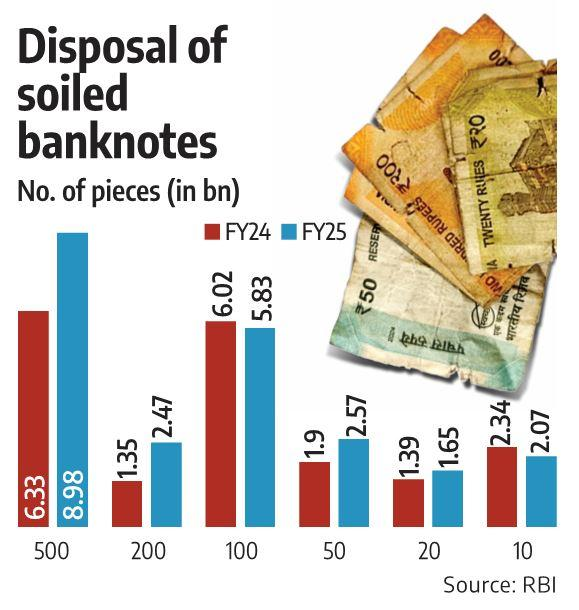
- India replaces 20-24 billion soiled notes under the Clean Note Policy every year & RBI spends about ₹5,000 crore a year on printing and managing currency.
- Enhanced Security: Polymer notes incorporate improved anti-counterfeiting technologies such as transparent windows, micro-printing, sophisticated holographic elements and embedded security features.
- The RBI data indicated that the number of counterfeit notes detected climbed to around 2.3 lakh pieces in 2025-26.
- Lower Lifecycle Costs: Higher cost of manufacture is offset by fewer replacement cycles, meaning less printing, transportation, storage and destruction of soiled notes.
- The earlier Life Cycle Impact Assessment of polymer notes by TERI has shown that the overall environmental footprint of polymer notes can be lower as a lesser number of notes need to be manufactured and transported over time.
Major Concerns
- High Production Cost: Polymer notes are 30-60% more expensive than cotton-paper notes.
- In some countries manufacturing costs for lower denominations have been in the vicinity of 20-24% of face value of the note, raising questions of cost-effectiveness.
- Petrochemical Dependence: The polymer substrates are made from polypropylene.
- India still imports a lot of polypropylene and so costs are vulnerable to crude oil prices, geopolitical tensions and supply disruptions in West Asia.
- Reliance Industries and Indian Oil Corporation are scaling up domestic capacities, but import dependence remains a strategic concern.
- Transition costs: The switch to polymer currency would require recalibration of ATMs, cash sorting machines, vending machines and currency processing equipment.
- Commercial banks, retailers and cash logistics firms would also face costs of adapting.
- Existing investments in paper currency: India has made substantial investments in domestic currency infrastructure including Bank Note Paper Mill India Pvt. Ltd and indigenous ink manufacturing facilities.
- Sudden shifts might mean these investments are under-utilised.
Digital Payments Paradox
- UPI’s Explosive Growth: Over 24,000 crore transactions a year, close to 85% of retail digital payments.
- RBI’s Currency Demand Paradox: Even if the growth of digital:
- The currency outstanding has surged from around ₹16-17 lakh crore nearly a decade ago to more than ₹41 lakh crore in 2025-26.
- Currency to GDP ratio is still over 11%, indicating physical cash is still in demand.
- Reasons include the informal economy, rural areas with poor digital connectivity, cash preference by households and small retailers, and precautionary cash holdings.
- It shows that digital payments and cash are complements rather than perfect substitutes.
- Trends in Currency Printing Costs: RBI Annual Reports indicated that the cost of currency printing was ₹5,101 crore (2023-24); ₹6,373 crore (2024-25); and ₹4,875 crore (2025-26).
Looking Forward
- Deploy in Phases: Don’t replace all denominations, but begin with ₹10 and ₹20 notes where durability benefits are highest.
- Build up domestic manufacturing: Atmanirbhar Bharat: Promote indigenous production of polymer substrates to cut down strategic dependence on imports.
- Full cost-benefit analysis: RBI to weigh lifecycle and transition costs, environmental and security benefits.
- Build recycling infrastructure: Set up recycling facilities to maximise environmental benefits.
- Continue with digital expansion: Polymer notes are meant to supplement, not replace, India’s digital payments strategy, ensuring financial inclusion where cash is still king.
Previous article
India using Too Many Powerful Antibiotics: Study
Next article
News In Short 23-07-2026
